Note Names
Composers learned that they needed to be able to represent music pitches on paper, allowing musicians to reproduce their musical compositions. They devised symbols (notes), placed on a series of lines and spaces (staffs) that would represent musical pitches.
On YouTube | Click here for closed captioned video | Click here if the video above is blocked | transcript of video
|
Clefs
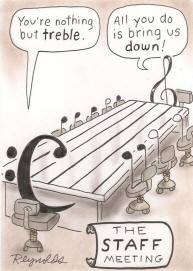
The most common staffs are the treble and bass and bass  clefs. Notice that both staffs consists of 5 lines (and 4 spaces between them). Each line represents a pitch, and is assigned a letter name (A,B,C,D,E, F or G). There is no musical note H; after G we start over with A again. clefs. Notice that both staffs consists of 5 lines (and 4 spaces between them). Each line represents a pitch, and is assigned a letter name (A,B,C,D,E, F or G). There is no musical note H; after G we start over with A again.
Click here to learn about the clefs:
http://www.musictheory.net/lessons/10 (Click on the  in the bottom right to go through the lesson) in the bottom right to go through the lesson)
|
 |
Lines and Spaces
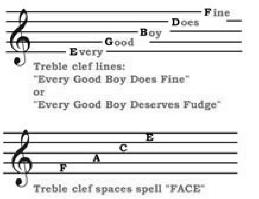 |
The Lines of the Treble Clef are (staring from the bottom) E, G, B, D, F
The Spaces of the Treble Clef are F, A ,C, E
Often, when learning the lines and spaces, students use mnemonics (a reminder technique) to remember these letter assignments; some of these are:
Every Good Boy Does Fine
Every Good Boy Deserves Fudge
Elvis's Guitar broke Down Friday
Every Girl Bites Dead Frogs
The Spaces are fairly easy to remember, they spell the word FACE.
|
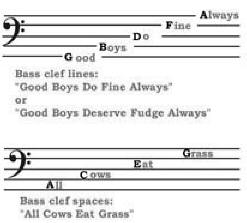 |
The Lines of the Bass Clef are (starting from the bottom) G,B,D,F,A
The Spaces of the Bass Clef are A,C,E,G
Some mnemonics to remember the Bass Clef Lines are:
Good Boys Do Fine Always
Good Boys Deserve Fudge Always
Groovy Boogie Dudes Find Action
The spaces of the Bass clef are A,C,E,G
All Cows Eat Grass
|
The Grand Staff
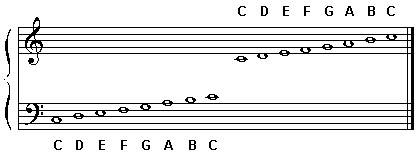
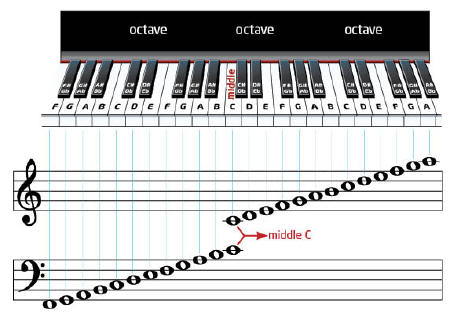
| When notes go above or below the staffs, musicians add additional lines, called ledger lines, that continue the alphabetic pattern. The space above the 'high' A on the bass clef is B. To put another note above the B space, we add a line to give us a place to put "middle C'. This note is called 'middle C' because it is the first ledger line above the Bass clef, and the first ledger line below the treble clef. Middle C joins the bass and treble clefs together.
In some music (keyboard and choral scores, for example) both the bass and treble clefs are joined together. This is called the Grand Staff.
|
 |
Go to this website to practice naming letter names. http://www.musictheory.net/exercises/note
(You will not need to know the bass, alto or tenor clefs for this course)
Flats and Sharps (Accidentals)
On YouTube | Click here for closed captioned video | Click here if the video above is blocked | transcript of video
The lines and spaces of the staff correspond to the white keys on the piano keyboard.
What about the black keys on the keyboard?
 |
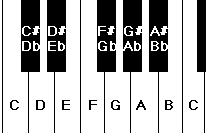
The notes represented by the black keys are called 'accidentals'. They produce pitches that are a half step either lower or higher than the 'natural' letters.
A pitch lower than the natural is called a 'flat'. The symbol for a flat is . .
A pitch higher than the natural is called a 'sharp'. The symbol for a sharp is
(The symbol for a natural note (the white keys) is  ). ). |
The black key immediately to the left of a white key (lower in pitch) will be called 'the letter name' flat.
For example, the black key to the left of 'G' is a Gb; to the left of the 'A' key is the note Ab.
The black key to the right of the 'F' would be F#; to the right of the 'G' is the key that will sound G#.
You may have noticed that the black key between the F and G is both a Gb and F#. This is correct. This phenomenon is called 'enharmonic'.
|
 |
Intervals: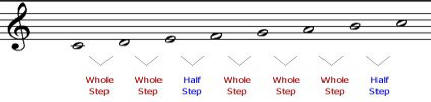
The distance between notes is called an interval. Scales are made up of intervals of whole and half steps.
These distances are also named by how far away from each other they occur - minor second, major second, minor third, major third, etc.
Singers need to know what these intervals sound like, so that they can sing songs they have never heard before (this is called sight reading).  Click here to hear these intervals and see some tunes that utilize these intervals.
Melody:
When you put a series of notes together, you create a melody. When you find yourself humming the notes of a song, you are recalling the melody of the song.
While playing the video to the right, watch and listen to how the notes on the staff correspond to the pitches of the melody (and the keys on the piano).
|
On YouTube | Click here if the video above is blocked|
|
Use the keyboard below to play notes on a keyboard. (you can make the keyboard larger by dragging the frame divider higher).
Then see if you can tell what the following melodies are:
#1 E E E, E E E, E G C D E
#2 E D C D E E E, D D D, E G G
#3 
#4 
once a flat or sharp are used once in a measure, that note continues to be 'altered' for the rest of that measure- so both G's in the first measure are Gb's)
#5
(scroll way down to get answers)
#1 'Jingle Bells'
# 2 , #3 and #4 'Mary Had A Little Lamb'
# 5 'Row, Row, Row your Boat'