| Assignment #2: Guitar Hero You already know what rhythm is - the beat of a song.  Prove it by playing Guitar Hero - Click here for instructions |
| Unit 3 - The Elements of Music | Notes and Staff | Scales and Key Signatures | Rhythms You are here |
Composing Music | Assignments |
Rhythm
| Assignment #2: Guitar Hero You already know what rhythm is - the beat of a song. Prove it by playing Guitar Hero - Click here for instructions |
So far, we have learned about the pitch of notes - notes also have different durations. Musical notation does not just indicate how 'high or low' a note is, but also how long to sustain that pitch.
View this site to get an introduction to rhythms https://www.musictheory.net/lessons/11 (Click on the  in the bottom right to go through the lesson)
|
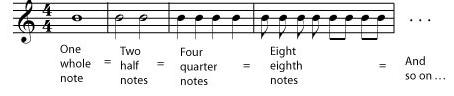
Here are the basic rhythmic notation symbols |
Time Signature
View this site to get an introduction to time signatures https://www.musictheory.net/lessons/12(Click on the in the bottom right to go through the lesson)
Watch these 2 videos to learn about Measures, Musical Beats, and Rhythmic Note Values:
On YouTube | Click here for closed captioned video | Click here if the video above is blocked | transcript of video
On YouTube | Click here for closed captioned video | Click here if the video above is blocked | transcript of video
Simple and Compound Rhythms
Most music can be categorized as having simple or compound rhythmic patterns. Simple rhythms can be divided by 2 beats, compound rhythms are made up of 3 underlying beats. A march is an example of simple rhythm - 1 2 3 4 1 2 3 4. A waltz has a compound rhythm feel - 123 123.
View this explanation at https://www.musictheory.net/lessons/15 (Click on the in the bottom right to go through the lesson)
Asymmetric or Additive rhythms
If the rhythm doesn't match either of the simple or compound rhythmic patterns (or changes back and forth) the rhythm is considered asymmetric.
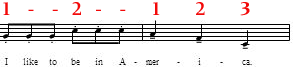
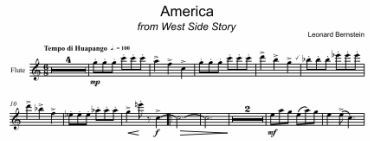
| A good example of asymmetric rhythm is "America" by Leonard Bernstein. If you try to tap your foot to this, you will find it difficult. The time signature is 6/8, but the first part of the melody is divided into 2 parts and the second part is divided into 3 parts.
|
| Assignment #3 - Rhythm Assignment Click here for directions |